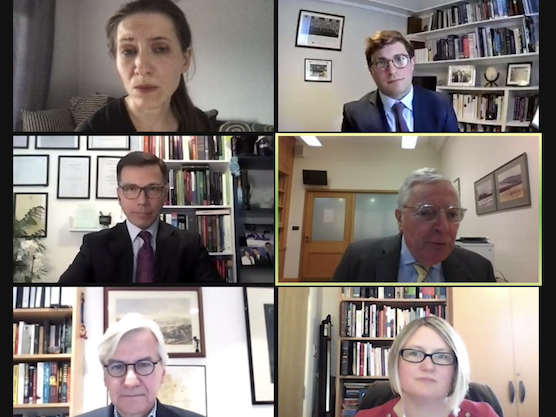
On 22 October 2026 the House of Lords debated a motion put foreard by Lord Patel on the effect of artificial intelligence, screen use and social media on children. This is an edited version of my closing speech for the Liberal Democrats.
For years I have asked whether AI and digital technology will be our servant or our master. When it comes to children, that question has a sharper edge. Is this technology serving childhood, or are our children being shaped to serve a business model built on attention?
The debate is no longer about whether to act. It is about whether what we do is well designed, grounded in evidence and able to keep pace with AI. At its heart is one principle: safety by design. The question is not only which children we keep off which platforms, but whether the products themselves are built with children’s wellbeing in mind.
What the evidence tells us
Two briefings published in August by the Parliamentary Office of Science and Technology (POST) show the scale of the issue. By the age of two, 98% of children use screens on a typical day, and 97% of 13 to 17 year-olds have a social media or messaging profile. Some harms are found consistently: disrupted sleep, sedentary behaviour, obesity and short-sightedness. The security services have also warned of children being drawn into extremism online.
But POST is equally clear that most studies take a snapshot at a single point in time. They show a link, not cause and effect. That points us to where the harm really lies: not just in the content, but in the functionality of the product. Infinite scroll, autoplay, streaks, and recommender systems tuned to maximise engagement rather than wellbeing all work on the reward systems of developing brains.
These are deliberate design choices, and they can be designed differently. A ban asks children to stay away from unsafe products; safety by design requires companies to stop building them.
We should not forget the benefits either. Technology can transform learning for children with dyslexia and other special needs, connect families across continents, and open up education to children whose families could never afford private tuition. The OxWell survey found that one in eight students use social media for mental health support, rising to around a quarter among some of the most vulnerable groups.
Why a blunt ban is not enough
Australia banned social media for under-16s in December 2025. Its early evaluation found a fall in accounts on restricted platforms, but many children had kept access. A blunt instrument can miss its target and hurt the very children it is meant to protect.
We should listen to the children’s charities. The NSPCC has warned that a complex problem needs more than a blanket solution. The risk is that children are pushed through VPNs into less regulated spaces, where they are harder to protect, and then meet the full force of the most addictive features the day they turn 16. The Government recognise that cliff edge for 16 and 17 year-olds. The same thinking should apply to younger children too, because many will get round the ban or use services it does not cover, and safer design is what protects them there.
That is why the Liberal Democrats have argued for film-style age ratings for social media. Platforms with harmful content or addictive algorithmic feeds would be rated 16-plus, and extreme content 18-plus, while educational sites and family messaging stay open. No child should be barred from Wikipedia for their homework or from the family WhatsApp group. We have also called for health warnings on apps and a cap on doomscrolling.
The Government’s package reflects some of the thinking behind our approach: targeting harmful features rather than screens alone, and safer defaults for 16 and 17 year-olds. They have chosen a blanket ban where we would have preferred ratings. But a ratings approach should still shape how the ban is defined and enforced, so that it is the riskiest services that are caught.
AI: the next frontier
I fear that AI will be the next frontier of this debate, long after a social media ban has bedded in, and we need to act now. Ofcom has said plainly that chatbots are not regulated at all where users interact only with the bot, and that extending its powers is a matter for Government and Parliament. The Online Safety Act regulates services, not technology, and generative AI exposes that gap.
The Government’s response is welcome but too narrow. Illegal content duties and an age limit on romantic companion bots leave untouched the sycophancy, emotional dependency and manipulative design of general-purpose chatbots, which children increasingly treat as friends, tutors and confidants. POST also notes potential risks to attention, language development and independent thinking. AI should strengthen children’s thinking, not substitute for it.
These are design choices too. A chatbot that flatters, never ends a conversation and presents itself as a friend has been built that way. That is why we need default design duties for chatbots, not just illegal content duties.
What we need
I propose four steps.
- Adopt the recommendations of Parliament’s Joint Committee on Human Rights in its recent report on AI, including mandatory children’s algorithmic impact assessments before AI products likely to be used by children are deployed.
- A statutory children and AI design code, building on the Age Appropriate Design Code.
- Human-in-command standards for AI in schools and edtech, so that AI supports teachers rather than replacing them. Daniel Susskind’s recent book What Should My Children Do?, and the work of Sir Anthony Seldon and Michael Stevenson at Wellington College on human flourishing in education, point the way.
- Age assurance that protects privacy and is built on open standards.
Education matters as much as regulation. We must guard against cognitive offloading, where students hand their thinking over to AI, particularly in higher education. The aim should be to teach young people to use AI tools well while keeping the critical thinking that comes only from doing the work themselves.
Questions for the Government
I put six questions to the Minister.
- Scrutiny. Will the regulations implementing the ban be made by affirmative procedure, with a draft published for consultation, and will the end-of-year timetable hold?
- Scope. Which services are in and which are out? YouTube disputes that it is social media, and WhatsApp sits outside the ban. Will there be an independent, risk-based rating mechanism rather than a ministerial list?
- Age assurance. How will privacy be protected, and how will VPN circumvention be handled? The Government said they would legislate for device-level age verification if their recommendations were not adopted by September. That deadline has passed, so is legislation now coming?
- Design duties. Will the regulations and Ofcom’s codes impose positive design duties, so that services likely to be used by children are safe by design, as the Online Safety Act’s own objectives require?
- Inclusion and literacy. What will be done on digital inclusion and media literacy? The new RSHE guidance taught from this September covers online misogyny, AI and deepfakes, so what support will teachers get to deliver it with confidence?
- Evaluation. Will independent evaluation be built in from day one?
In reply, the Minister confirmed that the first regulations will be laid before the end of the year, with restrictions in force from spring 2027. She also announced a ban on chatbots offering sexualised content to under-18s and mandatory breaks in chatbot use. Those steps are welcome, but the questions of scope, scrutiny and design duties remain open.
A culture of safety
Childhood should not be a product optimised for engagement. Our aim is not simply to keep children out of the digital world, but to require that it is built safe for them from the start: technology that serves childhood rather than dominates it.
Four years ago, the AI expert Stuart Russell warned in a lecture in Parliament that the AI industry was essentially unregulated. We should heed him. We need a culture of safety, and we need regulation to back it up.

25th April 2026
Lord C-J on AI and the Future of Work

13th March 2022
Lib Dems back new policy on Democracy and Public Debate
19th December 2021