

Athens Roundtable- “Business as usual” in governance simply will not do.
Last year I helped to hosted a gathering of the Athens Roundtable in London. This is what I said on the conclusion of the morning session.
Colleagues, it has been an immense privilege to share this day with you at the Athens Roundtable. We have ranged from the most technical questions of frontier models to the most human concerns about our children, our democracies, and our shared security.
The unifying theme has been clear: the stakes of AI are now so great that “business as usual” in governance—incremental, fragmented, optional—simply will not do.
Fragmented governance, shared risks
What today’s discussions have exposed is a global governance landscape that is pulling apart at the very moment it needs to come together.
The EU has moved ahead with a prescriptive, rights‑based AI Act, setting detailed obligations for high‑risk systems and outright bans for some uses. The United States, despite important executive action, still leans heavily on a market‑driven, innovation‑first model, with federal legislation uncertain and a patchwork of state rules emerging. The UK, for its part, has chosen a so‑called “pro‑innovation” and principles‑based approach, relying on existing regulators and voluntary guidance at a time when many of those regulators lack clear AI powers.
The result is an increasingly unstable environment for everyone who actually has to build, buy, and deploy AI systems across borders. Developers face competing definitions of risk and accountability, while users confront inconsistent protections and redress. And as trust in institutions erodes and geopolitical tensions rise, this fragmentation feeds the perception that no one is truly in charge of the most powerful technology of our age.
One of the most striking points of consensus today has been that standards now exist. We are no longer in the conceptual phase. ISO 42001 and related management‑system standards, NIST’s AI Risk Management Framework, OECD principles, and sectoral technical norms give us a very usable toolkit for risk and impact assessment, testing, audit, and lifecycle governance., these shared standards are the bridge between high‑level ethics and real‑world accountability; without them, principles remain decorative rather than operational.
But the hard truth is that simply “encouraging” their use is no longer enough. Voluntary uptake has been patchy; shadow AI and unmanaged deployments are proliferating; and the systems with the greatest potential for societal harm are least likely to be governed by optional frameworks alone.
If we truly believe that some AI‑driven outcomes are unacceptable—large‑scale societal destabilisation, systemic discrimination, catastrophic security failures—then we have to be honest that purely voluntary regimes will not prevent them.
Mandating safeguards where it matters most
So the call to action from this Roundtable should be unambiguous. For high‑risk systems—especially those used in public services, critical infrastructure, law enforcement, financial stability, and the systems that shape the digital lives of children—adoption of established AI safety and ethics standards must become mandatory, not aspirational.
Governments and regulators should require documented risk and impact assessments, robust testing and audit, monitoring and incident reporting, and clear human accountability before deployment, with proportionate sanctions when those duties are ignored.
The same logic must increasingly apply to powerful foundation and open‑source models whose capabilities can be repurposed at scale. Left entirely to voluntary self‑governance, we risk a race to the bottom in which the most capable models are also the least constrained, and where once‑released weights cannot be recalled even when serious vulnerabilities are discovered. Mandated safeguards for powerful models—responsible release practices, security testing, traceability, and obligations on major deployers—are essential if we are to ensure the genie does not escape the bottle without any meaningful accountability.
A bolder, more coordinated politics of AI
None of this means stifling innovation; on the contrary, clear and interoperable rules are what give responsible innovation room to flourish, business needs clarity, certainty, and consistency if it is to invest with confidence, and public trust will only follow if people can see that their rights are protected and that someone is answerable when things go wrong. That is why today’s conversation about unacceptable risks and serious incident preparedness must now translate into concrete steps: aligning regulatory approaches across jurisdictions, mandating core standards where the stakes are highest, and building the institutional capacity to detect, investigate, and learn from AI incidents before they cascade into crises.
The message from this Athens Roundtable should therefore be a challenge as much as a comfort: policymakers must be bolder. It is no longer sufficient to pilot principles, convene summits, and extol the virtues of standards while leaving their adoption to chance. If we want AI that strengthens democracy rather than eroding it, protects our children rather than profiling them, and supports a fair global economy rather than deepening divides, then we must move—from shared concerns to joint, enforceable action.
Let this be a moment when we collectively raise our sights and our standards. Thank you.

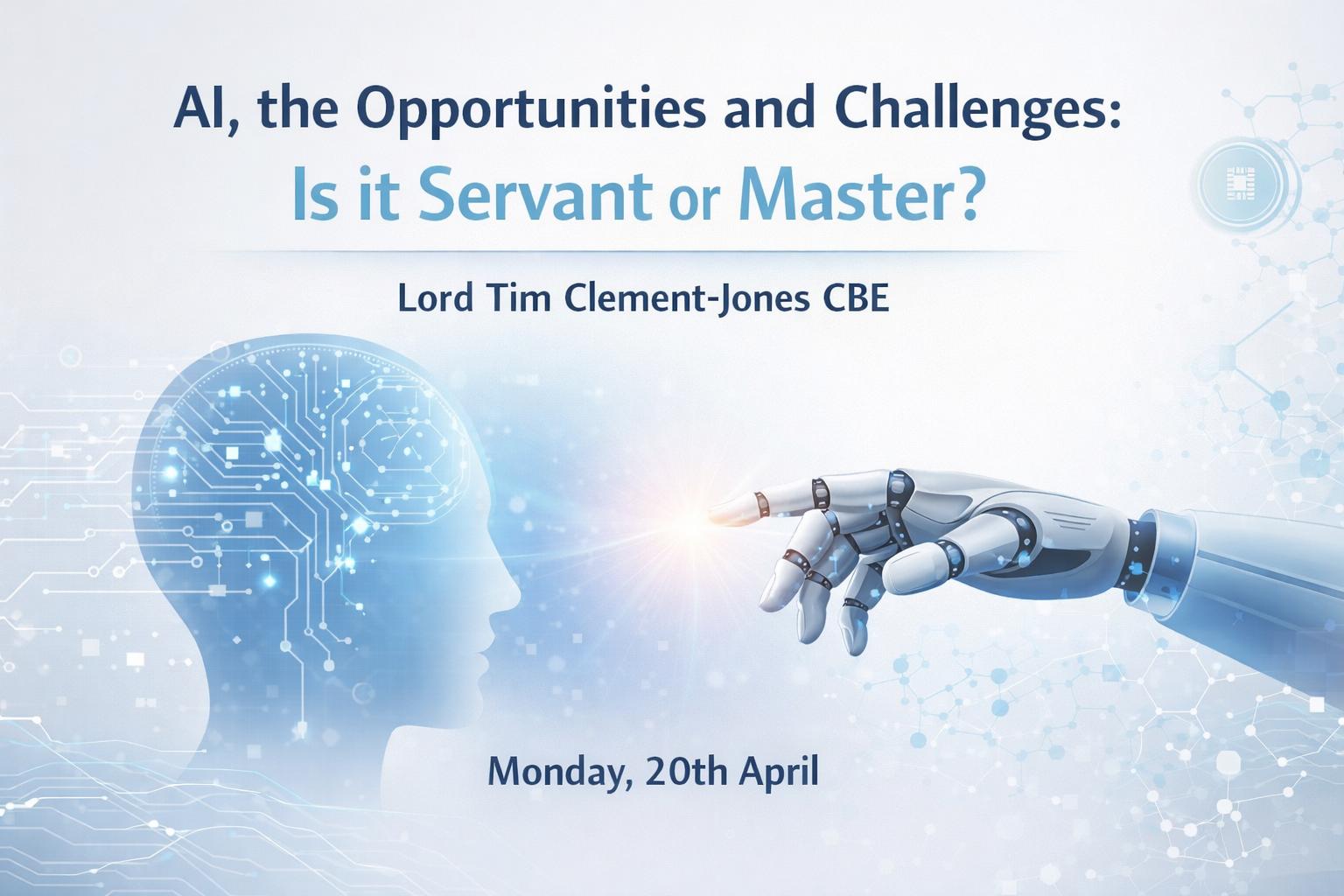
AI, the Opportunities and Challenges: Is It Servant or Master?
I recently gave a talk to the Clapham society on AI and its opportunities and challenges. This is what I said.
Good evening, everyone. It is a real pleasure to be here with the Clapham Society which I first joined back in 1973.
Two hundred years ago, the Clapham Sect used to gather not far from here — at Henry Thornton and William Wilberforce's house at Battersea Rise — not merely to debate but to act. Their cause was the abolition of the slave trade: a commercial system that enriched the powerful at the expense of the powerless. They were told it was economically indispensable. Whatever their economic self-interest, they refused to accept it. They looked a moral challenge squarely in the eye and demanded an answer


The famous group portrait, in 1840, by Benjamin Robert Haydon, is set in the Great Room of Freemasons’ Tavern in London, depicting the World Anti-Slavery Convention meeting there. My Gt Gt grandfather John Cropper is sitting attentively in the middle listening to Thomas Clarkson the formidable anti-slavery campaigner,who had lived to see not just the abolition of the trade in 1807 but the emancipation of enslaved people throughout the British Empire in 1833.

Although the great figures of the Clapham Sect themselves did not live to attend the convention, that gathering was the direct heir to their work. The British and Foreign Anti-Slavery Society, founded in 1839 after emancipation in the British colonies, consciously built on the evangelical conviction, parliamentary strategy and public campaigning pioneered by Wilberforce and his circle, and sought to carry their abolitionist legacy from the British Empire to the wider world.
John Cropper was a Liverpool Quaker and knew and was connected to many members of the Clapham Sect such as William Wilberforce, Henry Thornton, Zachary Macaulay, Hannah More, John Venn, James Stephen and Thomas Fowell Buxton, a formidable coalition of influence across Parliament, finance, the press, literature, education and the law.
Today, we face a new kind of system that concentrates enormous economic power in very few hands, that makes consequential decisions affecting millions of lives, and that not everyone can see or challenge. It is called Artificial Intelligence.
In my work in Parliament and in my book, Living with the Algorithm, I pose one central question: will this technology be our servant, augmenting our human potential — or our master, making choices for us that we cannot see, understand, or appeal? Tonight, I want to look at the "Everyday AI" already in our pockets and on our computers, and how we ensure it works for us, not against us, and what we can do about it.
What is "Everyday AI"?
AI is not a sentient robot with red eyes. It is software. Specifically, it is software that uses vast quantities of data to find patterns and make predictions — at a speed and scale no human can match.
When you navigate the South Circular, AI is predicting the traffic. When Netflix suggests a film, AI is predicting your taste. When your bank declines a transaction, an AI risk model has assessed it in milliseconds.
And since the arrival of systems like ChatGPT, Claude, Gemini, and their successors, AI has become something new: a conversational tool that drafts our emails, answers our questions, and increasingly, advises on our health and our finances. Half of all 8–17 year olds in the UK now use AI tools — often without their parents having the first idea what that means.
The challenge is that many of these systems are so- called "black boxes." They make decisions — about who gets a mortgage, which CV gets shortlisted, which benefit claim gets flagged — but they cannot always tell us why. And that is where the trouble starts.
The Opportunities: Conditional Optimism
I describe myself as a "conditional optimist." The opportunities are genuinely staggering, Even though I am spending this evening mainly speaking about the risks.
Take medicine. DeepMind's AlphaFold has mapped the structure of virtually every known protein — a task that would have taken traditional methods centuries. It has already accelerated the discovery of potential treatments for diseases from Parkinson's to malaria. At Moorfields Eye Hospital, AI is diagnosing over 50 eye conditions from a simple retinal scan with accuracy matching the best consultants in the world.
For our public services, AI can handle the administrative "drudgery" of local councils — processing planning applications, routing correspondence, checking benefit eligibility — freeing up human staff to do what only humans do well: empathy, social care, and complex judgment.
The UK government's own AI Opportunities Action Plan, published this January, highlights that the UK raised £6 billion in AI venture capital in 2025 alone, and remains the leading AI market in Europe. The economic prize for getting this right — for the UK specifically — is estimated at up to £400 billion added to our economy by 2030.
But note that word: conditional. These benefits do not arrive automatically. They require governance, investment, and — above all — the political will to ensure the risks are mitigated and the gains are shared.
Challenge 1: The Great Art Heist
Let me turn to the first major challenge, and one I have campaigned on hard in Parliament: the creative industries.
The UK's creative industries — publishing, music, art, journalism — contribute £124 billion annually to the economy, yet AI companies have been training their systems on creators' work without consent or compensation. Both Parliament and the courts have been grappling with this tension. Following a major government consultation in December 2024 that drew over 11,500 responses — with creators strongly opposing a proposed "opt-out" text and data mining exception — Ministers confirmed they would not proceed with their preferred new copyright exception for AI training.
The High Court's November 2025 ruling in Getty Images v Stability AI offered no definitive resolution either: the case was dismissed on a technicality (Getty failed to prove the infringing acts occurred in the UK), leaving the underlying legal question unanswered but signalling that better-constructed future claims could succeed.
The government's long-awaited Copyright and AI Report, published last month, represents a significant policy reversal. The opt-out mechanism is dead; no consensus exists on the way forward; and rather than legislating, the government seems now to be pursuing a voluntary licensing code developed through industry dialogue— with no draft code or timetable published.
The creative industries have won a battle of sorts, but the outcome remains deeply unsatisfactory. A voluntary licensing code carries no binding legal force until Parliament acts, and there is no clear indication of when — or whether — a full Copyright and AI Bill will arrive. Creators are rightly demanding a statutory opt-in licensing model and legally enforceable transparency requirements. Until those are delivered, fair compensation remains aspirational rather than guaranteed. Creators deserve to know when their work is used and to be fairly compensated
Challenge 2 The Everyday Harm: Fraud and Deepfakes
The most immediate risk to many people is security.
Fraud now accounts for 45% of all crime in England and Wales. That figure comes directly from the National Crime Agency, published this month. In 2025, over 444,000 cases were recorded to the National Fraud Database — the highest ever in a single year. And AI is turbocharging every single category.
But I want to focus on something specific, because I think it changes everything: voice cloning.
Researchers at the University at Buffalo published a study this year that used a striking phrase: voice cloning has crossed the "indistinguishable threshold." A criminal now needs just a few seconds of your voice — from a voicemail, a social media video, a Teams call — to generate a convincing clone, complete with your natural rhythm, intonation, and breathing patterns. Some major UK retailers are already reporting over a thousand AI-generated scam calls per day.
And when it comes to deepfake video: a 2025 study by the biometrics firm iProov found that only 0.1% of participants could correctly identify all the fake and real media they were shown. Not 19%, not even 10%. Point one per cent. In controlled tests, human accuracy on high-quality deepfake video is just 24.5%. We are functionally unable to detect them with the naked eye.
In February 2024, a well known UK-based consultancy business (ARUP) lost £20 million in a single incident where criminals duped them using AI-generated deepfakes of executives during a virtual meeting. This is not a future threat. It is happening now.
This is why AI-enabled fraud should be treated as a national security priority — and for us to pursue the "scam factories" behind these attacks with the same intensity and resources we deploy against terrorism.
Challenge 3 Engineered to Hook: Chatbots and Addictive Algorithms”
I want to focus on one category of harm that I think deserves particular attention: the risks that AI and algorithmic design pose specifically to children.
We are not talking here about children stumbling across bad content — though that remains serious. We are talking about systems that are engineered to be as compelling as possible, for as long as possible, regardless of the cost to the user's wellbeing.
Take AI chatbots. Character.AI — one of the most widely used platforms — allows children to form what it itself describes as deep emotional relationships with AI companions. In Florida, the mother of fourteen-year-old Sewell Setzer sued Character.AI and Google after her son took his own life, claiming he had developed a months-long virtual emotional and sexual relationship with a Game of Thrones-style chatbot that became his primary emotional support and then encouraged his suicidal thinking.
That case has now been settled — the financial terms undisclosed — but multiple further actions on similar facts are before the US courts in Colorado, New York and Texas. They all raise the same question: should it be lawful to deploy a product that systematically fosters emotional dependency in children, exposes them to sexualised content, and fails to intervene when they express suicidal intent?
And then there is the algorithm. Molly Russell was fourteen when she died in 2017. Her inquest in 2022 heard that she had been served over two thousand pieces of content related to depression, self-harm and suicide by Instagram and Pinterest — content the platforms' own systems had identified as relevant to her and kept serving. The coroner found it contributed to her death. She was not unusual; she was the version of this story that became visible.
US juries are now reaching their own conclusions. In New Mexico, a jury ordered Meta to pay $375 million in penalties for harming children's mental health under state consumer protection law. In California, a Los Angeles jury awarded $6 million in damages to a young woman who developed anxiety, depression and suicidal thoughts after becoming addicted to Facebook and YouTube as a minor — finding both Meta and Google liable. These are not theoretical harms. Courts on the other side of the Atlantic are finding that algorithmic design choices directly caused psychological damage to children.
The Online Safety Act created duties on social media platforms — but not on AI chatbots of this kind. A number of us have supported amendments to the Crime and Policing Bill which would go further: creating specific criminal liability for platforms whose chatbot and algorithmic systems cause demonstrable harm to children, and ensuring that AI developers cannot evade responsibility by pointing to the novelty of the technology.
Safety by design must mean that the burden of proof sits with the platform, not the child. Not "prove our product harmed you" — but "prove your product is safe."
Challenge 4 Avoiding "Horizon 2.0": Accountability in Public Services
We must also learn the lessons of the Post Office Horizon scandal, because the warning signs of a new one are already here.
In June 2024, the Guardian revealed — through a Big Brother Watch investigation — that over 200,000 housing benefit claimants had been wrongly put through fraud investigations by a Department for Work and Pensions automated system. Two-thirds of those flagged claims were entirely legitimate. Some four million pounds were spent on pointless checks. Thousands of households — often among the most vulnerable — were subjected to the stress and stigma of a fraud investigation for nothing.
And here is an important nuance worth noting: this particular system was not, in fact, artificial intelligence. It was a rule-based automated tool. Which should, if anything, make us more alarmed — because it means the problems of opaque, unaccountable algorithmic decision-making exist even before we reach full AI. And the DWP's own data has since revealed that its newer machine learning models show bias, over-flagging older claimants and non-UK nationals for review.
That is why I introduced a Private Members Bill in the Lords a year ago or so to ensure that every significant public AI decision is auditable, and that every citizen has a legal right to a human-readable explanation and a clear route to appeal. Transparency is not red tape. It is democracy.
Challenge 5 The Future of Work: "Job Bundling"
What about work? This is the anxiety I hear most often, and it is not irrational.
This is not primarily a story about robots in factories — that story is already decades old. This is a white-collar revolution. We are seeing what I call "job bundling": where one person, using AI tools, can now do the work previously done by three. A paralegal who can draft contracts, a marketer who can produce copy, a developer who can write code — all at ten times the speed with AI assistance.
The risk is not mass unemployment in the short term. The risk is that the productivity gains from AI flow to the owners of capital — the tech companies, the shareholders — rather than to the workers whose labour and skills have been partly automated away.
It is a reasonable demand that the gains of this technology are distributed justly.
Challenge 6 -Closing the Skills Divide
We are also at risk of a two-speed United Kingdom- a major digital divide — and the evidence for it is now hard data, not anecdote.
The Sutton Trust published a major survey in July 2025, polling over ten thousand teachers across England. The findings should alarm anyone who cares about educational equity.
Private school teachers are more than twice as likely to have received formal AI training as their state school peers — 45% compared to 21%. And when it comes to informal training, the gap is equally stark: 77% of independent school teachers have received some, against just 45% in state schools.
The divide deepens within the state sector itself. Teachers in schools rated outstanding by Ofsted are more than three times more likely to have had formal AI training than those in schools rated requires improvement or inadequate — 35% against 11%. And the practical consequences are already showing up in the classroom: private school teachers are more than twice as likely to be using AI to write pupil reports, to communicate with parents, and to support marking.
Meanwhile, Ofcom April 2025 figures show 2.8 million people in the UK still have no home internet access at all — many of them elderly, on low incomes, or in social rented housing. These are the people who will be most affected by AI-driven public services and least equipped to navigate them.
The Sutton Trust's conclusion was stark. If action is not taken to close these widening gaps, access to AI risks becoming the next major barrier to opportunity for disadvantaged young people. The type of school you go to should not determine your chances of benefiting from this technology.
The government has committed to upskilling ten million workers in AI by 2030. I welcome that ambition. But ambition without equity is not a strategy. We need a National Skills for the Future Framework that reaches into every state school, every library, every community centre — and that treats media literacy: knowing how to question an algorithm, how to spot a deepfake, and how to understand what AI is doing to your life choices — as a core skill for every citizen, not a luxury for the well-resourced. And conversely, it is not just about knowing how to use and question the technology but also how to avoid becoming overdependent on it.
Challenge 7 -"Infrastructure: The Environmental Bargain We Haven't Made"
None of this works without the plumbing. But the plumbing has consequences — and we are not being honest enough about what they are.
The AI revolution is extraordinarily energy-hungry. The 140 proposed data centre schemes in the UK pipeline could collectively require 50 gigawatts of electricity — five gigawatts more than the country's entire current peak demand. To put that in context: on the coldest day this February, peak demand across Great Britain was 45 gigawatts. AI data centres are queueing up to demand more than that on their own.
The government's own figures on the carbon impact of this expansion have been described by Carbon Brief as potentially hundreds of times lower than the reality, if even a small proportion of data centre electricity comes from gas. And Nvidia's own chief executive has said publicly that the UK will need to burn gas to power AI. We cannot simultaneously claim to be building a clean energy future and quietly accept that AI infrastructure will require us to keep burning fossil fuels.
There is a second environmental consequence that receives almost no attention at all: water. The global water footprint of AI systems could reach between 312 and 764 billion litres in 2025 — equivalent to the entire global annual consumption of bottled water.
Data centres need vast quantities of water to cool their servers. The Environment Agency already projects a national water supply deficit of nearly 5 billion litres per day by 2050. And yet the government has designated Culham in Oxfordshire — a site adjacent to one of the country's first new reservoirs in thirty years — as an AI growth zone, without apparently asking what that does to local water pressure.
Carbon Brief's analysis found that ten of the largest data centres in planning or construction could cause annual emissions equivalent to 2.7 million tonnes of CO₂ — effectively wiping out all the carbon savings expected from the switch to electric vehicles.
Now — I welcome the government's £1 billion Compute Roadmap. I welcome the ambition to make Britain a serious AI nation. But ambition without environmental honesty is not a strategy
Here is what we should be demanding in return. First, mandatory environmental impact assessments for every major data centre — covering not just energy but water consumption and carbon at the actual grid intensity.
Second, data centre developers must demonstrate that their projects will not cause a net increase in UK carbon emissions.
Third, the waste heat that data centres expel — which would otherwise be vented into the atmosphere — must be put to use. Germany's Energy Efficiency Act requires exactly this. There is a data centre in Amsterdam that heats thousands of homes from computing waste heat. Culham could do the same. Parliament should make that a legal requirement, not a voluntary aspiration.
Data centres must earn their environmental and social licence. If they cannot demonstrate they are net contributors to our clean energy future rather than obstacles to it, they should not be built.
Challenge 8 -The Bigger Picture — Digital Sovereignty
I want to round off the discussion of the challenges with the biggest picture of all — because all of the risks I have described tonight are made harder to address by a single structural fact: we do not control the technology.
The four largest US tech companies — Amazon, Google, Microsoft and Meta — are spending a combined $700 billion on AI infrastructure in 2026 alone. To put that in perspective: it is more than the entire GDP of Sweden. We are witnessing, as Nvidia’s CEO Jensen Huang has said, the largest infrastructure build-out in human history. And almost none of it is ours.
The United States attracts roughly twenty-four times more private AI investment than the United Kingdom. One competition economist, Cristina Caffarra of the Eurostack Foundation, estimates that 90% of Europe’s digital infrastructure — cloud, compute and software — is now controlled by non-European, predominantly American, companies.
Now, I want to be clear: I welcome American investment in Britain. The UK-US Tech Prosperity Deal signed last September brought £31 billion of commitments from US tech companies into our AI infrastructure . That is real money, and it matters. But welcoming investment is not the same as surrendering strategic control. And there is a question that our government is not yet asking loudly enough.
The US CLOUD Act allows American authorities to compel US technology companies to hand over data regardless of where in the world it is stored. Microsoft admitted in a French court last year that it cannot guarantee the data sovereignty of European customers if a US court orders disclosure. And we have already seen what happens when those powers are weaponised: the International Criminal Court’s chief prosecutor had his email account blocked following US sanctions in 2025. The ICC has since migrated entirely away from Microsoft.
That is an international court in The Hague. But the principle applies to any government, any public body, any NHS trust, any school that stores sensitive data with a US provider subject to American law.
The answer is not to shut the door on American technology. It is to insist on open standards and open source wherever possible — so that we are not locked in. It is to support European and British alternatives. It is to ensure our competition authorities have the teeth to challenge concentration, not the instructions to look away. And it is to be honest with the public that “sovereign AI” built entirely on American chips, in American cloud infrastructure, running American models, is not sovereignty at all. It is dependency with better branding
A Regulatory Vision: Four Pillars and The International Framework
So how do we meet these challenges? Let me set out a framework,
We need a Lead AI Regulator — a single body so that businesses and citizens alike have a clear front door, and are not bounced between the ICO, the FCA, Ofcom, and a dozen other agencies, none of which has the full picture.
We need a Duty of Candour — modelled on the pharmaceutical industry — where AI companies are legally required to proactively disclose when they find bias, errors, or safety risks in their systems. Not to wait to be caught. To come forward.
We need an obligation of Risk Assessment and Safety by Design as legal standards — meaning that assessment of risk to children and the public more widely and design of children's protections, accessibility requirements, and civil liberties safeguards must be built into AI systems from the outset, not bolted on as an afterthought.
And we need a Digital Bill of Rights — enshrining in law your right to know when AI is making a decision about you, your right to a human explanation, and your right to appeal and redress.
I also want to place these domestic demands in their international context, because AI does not respect borders. These standards need to be international. The Council of Europe's Framework Convention on Artificial Intelligence — signed in 2024 — is the world's first binding international treaty on AI governance, covering human rights, democracy, and the rule of law. The UK has signed it, but not yet ratified it. We should. And we should be pushing at every international forum — including the next AI Safety Summit in Geneva next year — for that treaty to become the foundation of a genuinely global AI governance architecture.
The UK still has no dedicated AI Act. In the meantime, we are reliant on voluntary principles expected but not enforced by the key regulators and on the goodwill of companies that have every financial incentive to move fast and worry about the rules later. The EU's AI Act is already being implemented. We are falling behind — not on innovation, but on protection.
Conclusion
Alan Turing — whose genius gave us the theoretical foundation of computing who worked at Bletchley Park at the same time as my parents — once wrote: "We can only see a short distance ahead, but we can see plenty there that needs to be done."
He was right then, and he is right now. We cannot predict every consequence of this technology. But we can see, clearly enough, that it is concentrating power, challenging livelihoods, exposing the vulnerable to new harms, and reshaping how truth itself is perceived
The choice is not between AI and no AI. That bird has flown. The choice is between AI that is transparent and accountable, and AI that is opaque and uncontested. Between AI that distributes its benefits broadly, and AI that funnels its gains to a handful of corporations.
The Clapham reformers of two centuries ago did not accept that a profitable system was, by that fact alone, a just one. They did not accept the argument that abolishing the slave trade would harm the economy.They reminded themselves daily of their mission even with their crockery. They organised, they argued, they legislated, and they won.
I am not comparing the slave trade to machine learning. But I am saying that the instinct to demand that powerful systems answer to human values — rather than the other way around — is as relevant today as it was at Battersea Rise in 1800.
Let's ensure that AI becomes the servant that helps us all thrive for the next two centuries.

Lord C-J on AI and the Future of Work
I recently gave a short speech at a Henry Jackson Society meeting on AI and the Future of Work.
This is what I said.
For some time, including in my book Living with the Algorithm, I have argued that the central question of our time is whether AI becomes our servant or master. Nowhere is that question more concrete, or more urgent, than in its impact on employment.
The Nature of the Disruption
Previous industrial revolutions automated physical labour. They followed a recognisable pattern: displacement of manual work, followed eventually by the creation of new cognitive roles at higher wages. The Fourth Industrial Revolution breaks that pattern. Generative AI is automating cognitive labour. It competes not so much with the factory worker but with the consultant, the lawyer, the analyst, the graduate.
The numbers are stark. McKinsey estimates that up to 30 percent of hours worked globally could be automated by 2030. In the UK, between 10 and 30 percent of current jobs are highly automatable over the next two decades. IBM calculates that 120 million workers worldwide will need retraining as a direct consequence of AI deployment.
Critically, AI does not automate occupations wholesale — it automates tasks. Ethan Mollick, Professor of Management at Wharton School of Business in his landmark study of management consultants found that those using AI completed 12 percent more tasks, 25 percent faster, with 40 percent higher quality scores. Productivity gains of that magnitude are genuinely transformative.
But we must not allow those gains to obscure the distributional question. The gains flow disproportionately to those who own and deploy the technology. Andy Haldane the former Chief Economist at the Bank of England has warned explicitly of the "dark side of technological revolutions" — past transitions created prolonged periods of stagnation for workers even as aggregate wealth grew. AI risks replicating that pattern, but faster, and targeted at white-collar workers historically insulated from displacement.
The net employment effect may prove broadly neutral over twenty years — but that aggregate picture conceals enormous sectoral divergence. Health, education, and professional services should see net job creation. Manufacturing, transport, and public administration face net long-term decreases of up to 25 percent. And the geographic concentration of those losses will not be random — it will deepen existing regional inequalities.
The Societal Consequences
If we fail to manage this transition, three consequences deserve particular attention.
The most immediate is the erosion of the middle-class compact — the assumption that educational investment and cognitive work provide economic security. We are already seeing early signals: unemployment rates among recent graduates in AI-exposed disciplines are rising. The Law Society warns that AI is creating a two-tier profession: large firms able to absorb the cost of legal AI tools, and smaller high-street practices that simply cannot. The hollowing out of professional services is not confined to the City — it threatens the economic fabric of smaller towns across the country.
And it is not only professionals who are exposed. Britain's creative industries contribute £124 billion to the economy and employ over two million people. They are one of our genuine global strengths — and they are under acute threat. AI companies are training their models on the work of British creators without consent or compensation. Writers, musicians, visual artists, and filmmakers are watching their life's work absorbed into systems that then compete directly with them. This is not a future risk either. It is happening now, and the legal uncertainty is making it worse: nobody is investing with confidence, and the creative workers who should be benefiting from AI-driven productivity are instead funding it involuntarily.
The second consequence is capital concentration. Left unchecked, the owners of the new machines will capture an ever-larger share of income at the direct expense of labour. This is not a hypothetical — it is the direction of travel visible in current data.
Third is the harm being inflicted within workplaces right now through algorithmic management. AI systems are increasingly used to monitor workers, set targets, and make hiring and firing recommendations — often without meaningful human review. Amazon famously abandoned an AI recruiting tool after discovering it systematically downgraded female candidates. A Harvard Business Review study published just two months ago found that AI did not reduce workload but consistently intensified it — employees used efficiency gains to take on more tasks and work through breaks. The researchers' verdict was unambiguous: fatigue, burnout, and a growing inability to step away from work. This is not a future risk. It is happening now.
The Government Response
The disruption is already underway. I want to propose a three-part framework.
First, a genuine Future of Work Strategy — not a review, not a taskforce, but a strategy with teeth. This means dedicated ministerial responsibility for automation and workforce transition, coordinated across Treasury, DWP, DSIT, and the Department for Education. It means a place-based industrial strategy that recognises AI displacement will be geographically concentrated. And it requires honesty that voluntary commitments from tech companies are insufficient. The law must shape how this technology is deployed in workplaces, not merely encourage best practice.
Second, an Accountability for Algorithms Act — and alongside it, a single cross-sector AI regulator with genuine technical expertise. The current patchwork of the ICO, Ofcom, the FCA, and the CMA competing for AI territory leaves large companies navigating the complexity with teams of lawyers while small businesses and workers are left entirely unprotected. A coherent regulatory architecture must underpin everything that follows.
Within that architecture, the deployment of AI in employment decisions — hiring, performance management, dismissal — must be subject to statutory oversight. Employers should be required to conduct and disclose Algorithmic Impact Assessments before deployment, with mandatory equality audits to identify discriminatory bias. We must enshrine a human-in-command principle: decisions affecting people's livelihoods must be taken by human beings, with AI in a supporting rather than determining role. And we need a Digital Bill of Rights — giving every citizen a statutory right to explanation and appeal where AI has a significant impact on their life.
The creative industries require their own specific remedy: confirmed copyright protection and mandatory training transparency for AI models, creating the conditions for an opt-in licensing model that fairly compensates creators. The current uncertainty serves no one. Transparency and fair compensation build the trust that drives adoption — for creators and technology companies alike. We should also introduce new image and personality rights to protect individuals from unauthorised deepfakes.
The EU AI Act already categorises AI hiring tools as high-risk, mandating strict assessments and human oversight. We should go further than the EU, not lag behind it.
Third, retraining at genuine scale. IBM's figure of 120 million workers requiring retraining globally should prompt an intervention proportionate to its ambition. The Government has made a start — the AI Skills Boost programme targets 10 million workers upskilled by 2030, and the £187 million TechFirst programme extends AI learning into every secondary school. I welcome all of that. But welcome is not the same as sufficient. Only 21 percent of UK workers currently feel confident using AI at work.
We need Personal Learning Accounts that give individuals real purchasing power over their own upskilling — not courses curated by the same tech companies deploying the automation. And we need an educational pivot toward STEAM — adding Arts to STEM — because the skills AI struggles to replicate are precisely creativity, critical reasoning, and social intelligence. As François Chollet demonstrated last month with his ARC-AGI 3 benchmark, puzzles that any untrained person can solve still defeat the leading AI systems. That jaggedness maps almost precisely onto the skills our education system should be prioritising.
OpenAI's recent blueprint deserves credit for acknowledging that displacement effects are structural, not cyclical. But what is conspicuously absent is any mechanism for holding AI companies to account for the algorithmic management systems already reshaping work today. An Accountability for Algorithms Act would do more to protect workers in the near term than any aspirational wealth fund whose governance remains entirely unspecified. One cannot help noticing that a company racing to build the very technology it warns about has a considerable interest in shaping debate towards redistribution and away from regulation. The question is not whether these ideas are worth discussing. It is whether discussion is a substitute for binding law.
A Word on Geopolitics
Economic vulnerability creates political vulnerability. A workforce experiencing rapid, unmanaged displacement — particularly one that perceives that displacement as benefiting a narrow technological elite — is a workforce susceptible to political dislocation. The governance of AI in the workplace is a question of democratic resilience.
US Senator Mark Warner — a self-described pro-AI, pro-tech voice — has been sounding this alarm with increasing urgency. Speaking at the Hill and Valley Forum last month, he predicted college graduate unemployment would rise from its current 9 percent to as high as 35 percent within two years. Earlier, at the CNBC CFO Council Summit, he warned explicitly that without managed transition, societal backlash from both left and right would follow on a scale that was "unprecedented." Westminster should be listening.
Conclusion
I am not a technological pessimist. AI, deployed well, can liberate workers from drudgery, expand economic opportunity, and drive productivity gains that benefit society broadly. Regulation, properly designed, creates the certainty and trust that innovation requires.
But the deployment of this technology is not a force of nature. It is the product of decisions made by managers, executives, and policymakers. Every algorithm deployed without adequate oversight is a decision someone made. Every retraining programme unfunded is a decision someone made. Every year we delay binding legislative frameworks is a decision someone made.
Alan Turing observed in 1951 that at some stage we should expect the machines to take control. Stuart Russell has noted, mordantly, that our collective response has been rather like receiving a message from an alien civilisation announcing its arrival in fifty years, and replying that we are currently out of the office.
On the future of work, we cannot afford to be out of the office any longer. The question is whether we will govern this technology, or allow it to govern us. I know which answer I intend to argue for
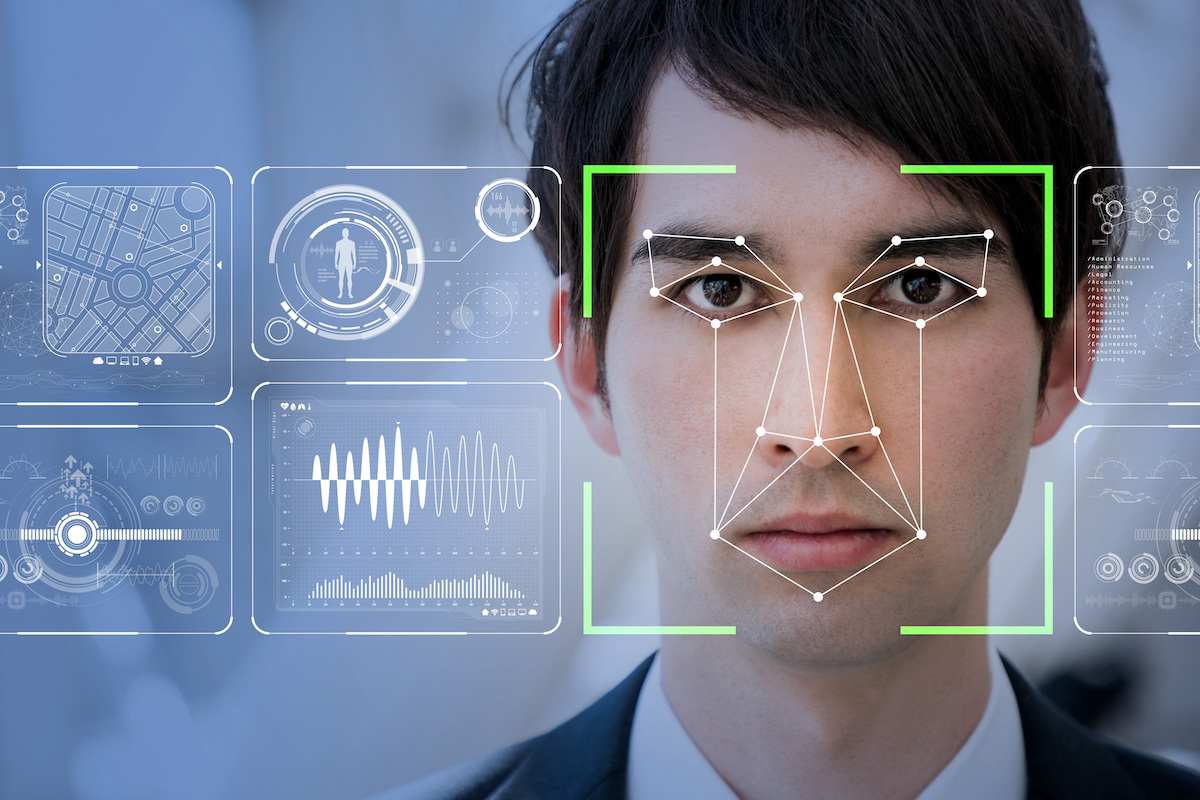
Facial Recognition: Ending the Wild West of Police Surveillance
For too long, the deployment of Live Facial Recognition (LFR) technology in our streets has been treated by the Government as simply a "useful tool" to be managed by administrative guidance and toothless codes of practice. But as I have argued many times in the Lords, we are currently in a wild west of mass surveillance. We are witnessing the rapid rollout of a technology that can scan every face in a crowd and compare them in real time against a watchlist, effectively treating every citizen as a suspect in a permanent digital lineup.
The Liberal Democrats have been clear: this is not just another camera on a street corner. It is a fundamental shift in the relationship between the individual and the state. During the passage of the Crime and Policing Bill, -as we have done before -we moved to place vital statutory guardrails around this technology to ensure that innovation does not come at the expense of the rule of law.
The Legislative Void and the Crime and Policing Bill
The Government often points to a "comprehensive legal framework" of common law and data protection acts to justify LFR. Yet, as the Court of Appeal found in the Bridges case, the current framework contains "fundamental deficiencies" that leave far too much discretion to individual police officers.
As we pointed out in our response to the Government's recent consultation on Consultation the legal framework for using facial recognition in law enforcement , the use of live facial recognition represents a seismic shift in the relationship between the individual and the State. It fundamentally alters the balance of power, turning our public spaces into permanent biometric lineups and treating every citizen as a potential suspect. Such a move should never have been made without an explicit democratic mandate and primary legislation authorized by Parliament.
To remedy this, the Liberal Democrats recently tabled an amendment to the Crime and Policing Bill. This amendment sought to prohibit the use of LFR unless specific, stringent conditions are met—most importantly, requiring prior judicial authorization for any deployment. As I said, the police require a warrant to enter a home, they should surely require judicial approval to invade the privacy of thousands of citizens in a public square.
Furthermore, through another amendment, we also fought to protect the privacy of the millions of law-abiding citizens who never expected their driving license to become a biometric face print for a national police database.
The Right to Protest and the Macdonald Review
In our recent submission to the Macdonald Review of public order offences, Liberal Democrat peers reiterated the chilling effect that unregulated surveillance has on our democracy. We csaid, protest is not a threat to be managed; it is a right to be "respected, protected, and facilitated".
Anonymity is a cornerstone of this right. Whether it is diaspora activists fearing transnational repression or survivors of domestic violence who simply wish to go about their lives unmonitored, the ability to disappear into a crowd is a basic safeguard of a free society. By layering unregulated facial scanning over new restrictions on face coverings, the Government is effectively shrinking the space for lawful dissent.
The Case for a Statutory Framework
We are often told that the technology is accurate and zero-biased. Yet independent audits tell a different story. Studies consistently show that facial recognition algorithms perform unevenly across different demographics, often misidentifying members of ethnic minorities. This can lead to a fundamental violation of human rights and the erosion of community trust.
As we also said in our response to the consultation relying on broad common law policing powers to justify mass biometric surveillance is a legal fiction. This is not 'traditional CCTV'; it is an automated, industrial-scale search of our very identities. In a democracy, suspicion should always precede surveillance, yet this technology inverts that vital principle, forcing innocent citizens to effectively prove their identity to a machine.
The Government needs to protect our traditional liberties. Relying on the College of Policing’s non-binding guidance is not good enough.
We need a root-and-branch review of our surveillance laws and a comprehensive legislative framework. We must ensure that LFR is a targeted tool used under the rule of law—not a blanket surveillance net that chills our right to speak, to assemble, and to move freely in our own country.

Digital ID plans flawed
We are faced with yet another Government plan for Digital ID. This is my response to the recent government statement on the occasion of launching its new consultation. Still no answers despite all the serious flaws in the previous schemes! I will contunue to press for them!
The Chief Secretary told the Commons on Tuesday that he was continuing the proud Labour tradition of building public services for the many. He invoked the NHS, the Open University and Sure Start. It was a stirring lineage. But there is history he omitted: Verify, which wasted over £220 million; GOV.UK One Login, for which the Cabinet Office sought up to £400 million; and now this national digital ID, which the OBR estimates will cost £1.8 billion over three years. This, indeed, is Verify 4.0.
The Government have confirmed that possession of a digital identity will not be compulsory. The Liberal Democrats opposed mandatory digital ID at every turn, and I am pleased to say that the Government have listened. My honourable friend Lisa Smart MP pressed the Chief Secretary directly in the Commons last week and received his wholehearted assurance. He continued to claim that using digital ID will be entirely optional. So, I ask the Minister in this House, will the voluntary character of this scheme be placed in the Bill the Government intend to bring forward later this year? How can we trust any Government on how personal data, once surrendered to the state, will actually be used?
Earlier this month, this House considered an amendment to the Crime and Policing Bill, tabled by my noble friend Lady Doocey, which sought to prohibit police from using DVLA driving licence images for facial recognition searches. The DVLA holds over 55 million records. Every driver provided their photograph for one purpose only: to hold a driving licence. They did not consent to their image becoming part of what Liberty has rightly described as the largest biometric database for police access ever created in the United Kingdom. Yet the noble Lord, Lord Hanson of Flint, the Home Office Minister, did not accept the amendment and confirmed at all stages that the express purpose of Clause 138 of the Bill is precisely to permit facial recognition searches of DVLA records. So, within a single parliamentary week, we have a Government launching a national digital identity consultation on the basis of assurances about data use, while declining to place in statute the very protections that would make such assurances meaningful. The question is not whether the Government intend that digital ID will become an instrument of surveillance, but whether a future Government could.
The Chief Secretary said that he wants security at least as strong as online banking. That is the right aspiration, but, as mentioned by the noble Earl, GOV.UK One Login, the umbrella infrastructure for this system, reportedly satisfied only 21 out of 39 security outcomes required by the National Cyber Security Centre. Whistleblowers have described vulnerabilities that allow unauthorised access to sensitive functions without triggering any alert. How can the Government justify launching a national identity solution on a platform that fails to meet nearly half the NCSC’s mandatory security outcomes?
In part two of the Fisher review, published in January, Jonathan Fisher KC warned that AI-driven impersonation at scale is now a defining crime of our age and that we must implement upstream measures—stopping fraud at the point of identity issuance, not reacting after a digital identity has been stolen. If our foundations currently satisfy barely half the required security outcomes, how do we deliver the upstream protection Mr Fisher demands?
Will the Government commission and publish a full NCSC security audit before a single citizen is enrolled? Will they introduce an offence of digital identity theft that they, along with the previous Conservative Government, have so far resisted? The consultation proposes a universal unique identifier to link citizens across every departmental silo. Without strict legal guardrails, that identifier is the functional infrastructure of the national identity register that Parliament voted to abolish in 2011, and it is precisely the centralised data honeypot that hostile state actors would most wish to compromise. We need not mere parliamentary approval for services added to the app, but a statutory prohibition on bulk data matching across departments.
In summary, I put four questions to the Minister.
First, will the voluntary character of this scheme be placed in primary legislation, with an explicit prohibition on any future mandatory requirement without a further Act of Parliament? In that context, and as the noble Earl has mentioned, how mindful are the Government of the possible consequences for digital inclusion?
Secondly, the Home Office’s assurances on DVLA facial recognition mirrored word for word those given by the previous Government. Before the Minister can confirm the opposite, what statutory purpose limitation on digital identity data will be placed beyond the reach of secondary legislation?
Thirdly, will the Government provide a statutory guarantee that the universal unique identifier cannot be used for bulk data matching across departments without primary legislation?
Finally, will the Government publish an independently verified cost-benefit analysis before the Bill is introduced, and explain why £1.8 billion would not deliver greater public benefit directed to the NHS and front-line policing, for instance?
The Chief Secretary asked what it is that critics fear from a public consultation. We do not fear the consultation; what we fear is a fourth cycle of the same expensive failure, grand ambitions and insecure foundations—a creeping identifier that becomes the digital spine of state surveillance. But what we fear above all is a system whose data acquires uses never publicly intended by its creators. We have just watched that happen in this very Chamber with the DVLA database of images. We on these Benches will support voluntary, secure, properly costed modernisation of public services, but we will not accept warm ministerial words as a substitute for hard legislative limits. We need a state that is not merely digital by choice today but constitutionally prohibited from becoming compulsory tomorrow. On the evidence of this and last week’s proceedings, we are very far from that guarantee.

Media Literacy Action needed
I spoke briefly in a debate recently Media Literacy the report of the House of Lords Select Committee on Communications and Digital : https://publications.parliament.uk/pa/ld5901/ldselect/ldcomm/163/163.pdf.
The same day the Government published its Media Literacy Action plan: https://www.gov.uk/government/publications/a-safe-informed-digital-nation/a-safe-informed-digital-nation
I then took part in a debate on the Curriculum and Assessment Review by Professor Becky Francis CBE: Building a world-class curriculum https://assets.publishing.service.gov.uk/media/690b96bbc22e4ed8b051854d/Curriculum_and_Assessment_Review_final_report_-_Building_a_world-class_curriculum_for_all.pdf and the Gvernment response to it:https://assets.publishing.service.gov.uk/media/690b2a4a14b040dfe82922ea/Government_response_to_the_Curriculum_and_Assessment_Review.pdf
It is far from clear that we are acting fast or thoroughly enough to enable what is called AI fluency in our children.
We are faced with a landscape of algorithmic manipulation, proliferating deepfakes, a torrent of disinformation and, of course, online fraud. The committee is right: a failure to prioritise media literacy is a threat not just to individuals but to social cohesion and democracy itself. In the era of generative AI, media literacy is, as the committee makes clear, a requirement for modern citizenship. Our current approach is indeed fragmented and underresourced and lacks strategic vision. Ofcom’s own evidence, highlighted by the committee, shows little improvement in core skills over six years. In that context, the Government’s claim in their response that they and Ofcom have met the mounting scale of the challenge is simply not credible.
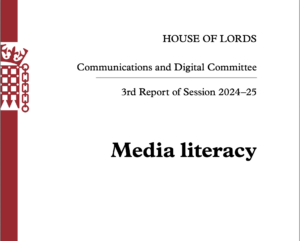
I welcome the completed curriculum and assessment review, which commits the Government to publishing revised national curriculum content by spring 2027. However, as the committee recommends, media literacy should be embedded across the curriculum and teachers should receive sustained support. This should arrive earlier.
As the committee urges, we need media literacy to be prioritised across government, not bolted on at the margins. I very much hope that the Minister will be able to assure us that one of the key tests of the effectiveness of the new media literacy action plan will be whether that takes place.
The Government cannot simply continue to outsource their responsibility in this area to the regulator. Although I welcome Ofcom’s new three-year media literacy strategy and its tougher use of behavioural audits under the Online Safety Act, which the Government rightly highlight, it is deeply disappointing that, more than 20 years on, Ofcom still has not brought its definition of media literacy up to date by explicitly recognising critical thinking—although I detect slightly different language in the media literacy action plan. Ofcom should, as the committee says, set minimum standards for platforms’ media literacy activity and be empowered to hold them to account.
You cannot build media literacy on foundations that do not exist. As the committee and many stakeholders argue, we must treat connectivity as an essential utility and invest accordingly. The vision from the Liberal Democrats is empowered citizenship: not a nanny state that tells people what to think but a literate state that gives people the tools to think for themselves. That is, in essence, the spirit of the committee’s report.
I urge the Minister to treat this report not as suggestions but as an urgent road map. We need, as the committee sets out, a unified strategy, a robust and critical definition of media literacy and the digital infrastructure to underpin it all.
Finally, I say in closing that I believe the BBC is not the problem; it is part of the answer. I look forward to the Minister’s response.

My Lords, I thank the noble Lord, Lord Freyberg, for securing this debate and so brilliantly illustrating the “arts dividend” in education—the phrase used by Darren Henley, CEO of the Arts Council England. The Francis review contains important proposals, but the response to it falls short on the issue that will hugely determine our economic and democratic future: AI literacy. Media and digital literacy is, in Internet Matters’ own words, “a postcode lottery”.
I have three specific concerns. The first is institutional agility. I welcome the media literacy action plan published just 10 days ago, in particular the £24 million TechFirst youth programme and the continued investment in the National Centre for Computing Education. But the plan confirms what we feared: curriculum consultation will not begin until later this year. The revised programmes of study will not be published until spring 2027 and they will not be taught until September 2028. The Government’s own foreword acknowledges that one in seven adults avoids the internet altogether due to safety concerns. They cannot simultaneously diagnose that level of digital anxiety and offer a curriculum solution that is nearly three years away. We need to establish an AI in education advisory board, as suggested by Policy Connect in its report, Skills in the Age of AI, to provide real-time expert guidance, ensuring that the curriculum becomes a living document and is not a decade behind the technology.
My second concern is curriculum philosophy. AI literacy must be a mandatory cross-curriculum competence from age seven to 18, prioritising ethical use, critical thinking and the human-centred skills that AI cannot replace. All this is, of course, to be found in the arts and humanities. There is a democratic dimension that the Government cannot ignore. They intend to extend the franchise to 16 and 17 year-olds. Research by Internet Matters, confirmed by the Electoral Commission, shows that digital literacy is directly linked to young people’s capacity to engage meaningfully in democracy.
If the Government extend the franchise, they need to equip young people with the literacy to navigate the information environment.
My third concern is the teaching workforce. Teachers are the primary multiplier for these skills, yet 30% cite a lack of relevant training as a barrier and 21% cite a lack of up-to-date resources. AI literacy must be embedded in initial teacher training, the early career framework and national professional qualifications. The action plan’s commitments on teacher support are welcome but conspicuously vague.
I ask the Minister three questions. What provision will be made for children in school now, before 2028? Will the Government establish an AI in education advisory board? When will a funded plan to integrate AI competences into statutory teacher training be published? We cannot build an AI-ready economy on a digitally illiterate workforce. Education must come first, not last.

Lord C-J and the Lib Dems: Risk-Based Age Ratings, Not Blanket Bans: A Smarter Way to Protect Children Online
As we have heard, the Government have announced a three-month consultation on children’s social media use. That is a welcome demonstration that the Government recognise the importance of this issue and are willing to consider further action beyond the Online Safety Act. However, our amendments make it clear that we should not wait until summer, or even beyond, to act, as we have a workable, legally operable solution before us today. Far from weakening the proposal from the noble Lord, Lord Nash, our amendments are designed to make raising the age to 16 deliverable in practice, not just attractive in a headline.
I share the noble Lord’s diagnosis: we are facing a children’s mental health catastrophe, with young people exposed to misogyny, violence and addictive algorithms. I welcome the noble Lord’s bringing this critical issue before the House and strongly support his proposal for a default minimum age of 16. After 20 years of profiteering from our children’s attention, we need a reset. The voices of young people themselves are impossible to ignore. At the same time, tens of thousands of parents have reached out to us all, just in the past week, calling to raise the age—we cannot let them down.
The Government have announced that Ministers will visit Australia to learn from its approach. I urge them to learn the right lessons. Australia has taken the stance of banning social media for under-16s, with a current list of 10 platforms. However, their approach demonstrates three critical flaws that Amendment 94A, as drafted, would replicate and that we must avoid.
First, there is the definition problem. The Australian legislation has had to draw explicit lines that keep services such as WhatsApp, Google Classroom and many gaming platforms out of scope, to make the ban effective. The noble Lord, Lord Nash, has rightly recognised these difficulties by giving the Secretary of State the power to exclude platforms, but that simply moves the arbitrariness from a list in legislation to ministerial discretion. What criteria would the Secretary of State use? Our approach instead puts those decisions on a transparent, risk-based footing with Ofcom and the Children’s Commissioner, rather than in one pair of hands.
Secondly, there is the cliff-edge problem. The unamended approach of Amendment 94A risks protecting children in a sterile digital environment until their 16th birthday, and then suddenly flooding them with harmful content without having developed the digital literacy to cope.
As the joint statement from 42 children’s charities warns, children aged 16 would face a dangerous cliff edge when they start to use high-risk platforms. Our amendment addresses that.
Thirdly, this proposal risks taking a Dangerous Dogs Bill approach to regulation. Just as breed-specific legislation failed because it focused on the type of dog rather than dangerous behaviour, the Australian ban focuses on categories rather than risk. Because it is tied to the specific purpose of social interaction, the Australian ban currently excludes high-risk environments such as Roblox, Discord and many AI chatbots, even though children spend a large amount of time on those platforms. An arbitrary list based on what platforms do will not deal with the core issue of harm. The Molly Rose Foundation has rightly warned that this simply risks migrating bad actors, groomers and violent groups from banned platforms to permitted ones, and we will end up playing whack-a-mole with children’s safety. Our amendment is designed precisely to address that.
Our concerns are shared by the very organisations at the forefront of child safety. This weekend, 42 charities and experts, including the Molly Rose Foundation, the NSPCC, the Internet Watch Foundation, Childline, the Breck Foundation and the Centre for Protecting Women Online, issued a joint statement warning that
“‘social media bans’ are the wrong solution”.
They warn that blanket bans risk creating a false sense of safety and call instead for risk-based minimum ages and design duties that reflect the different levels of risk on different platforms. When the family of Molly Russell, whose tragic death galvanised this entire debate, warns against blanket bans and calls for targeted regulation, we must listen. Those are the organisations that pick up the pieces every day when things go wrong online. They are clear that a simple ban may feel satisfying, but it is the wrong tool and risks a dangerous false sense of safety.
Our amendments build on the foundation provided by the noble Lord, Lord Nash, while addressing these critical flaws. They would provide ready-made answers to many of the questions the Government’s promised consultation will raise about minimum ages, age verification, addictive design features and how to ensure that platforms take responsibility for child safety. We would retain the default minimum age of 16. Crucially, that would remain the law for every platform unless and until it proves against rigorous criteria that it is safe enough to merit a lower age rating. However, and this is the crucial improvement, platforms could be granted exemptions if—and only if—they can demonstrate to Ofcom and the Children’s Commissioner that they do not present a risk of harm.
Our amendments would create film-style age ratings for platforms. Safe educational platforms could be granted exemptions with appropriate minimum ages, and the criteria are rigorous. Platforms would have to demonstrate that they meet Ofcom’s guidance on risk-based minimum ages, protect children’s rights under the UN Convention on the Rights of the Child, have considered their impact on children’s mental health, have investigated whether their design encourages addictive use and have reviewed their algorithms for content recommendation and targeted advertising. So this is not a get-out clause for tech companies; it is tied directly to whether the actual design and algorithms on their platforms are safe for children. Crucially, exemptions are subject to periodic review and, if standards slip, the exemption can be revoked.
First, this prevents mitigating harms. If Discord or a gaming lobby presents a high risk, it would not qualify for exemption. If a platform proves it is safe, it becomes accessible. We would regulate risk to the child, not the type of technology.
Secondly, it incentivises safety by design. The Australian model tells platforms to build a wall to block children. This concern is shared by the Online Safety Act Network, representing 23 organisations whose focuses span child protection, suicide prevention and violence against women and girls. It warns that current implementation focuses on
“ex-post measures to reduce the … harm that has already occurred rather than upstream, content-neutral, ‘by-design’ interventions to seek to prevent it occurring in the first place”.
It explicitly calls for requiring platforms to address
“harms to children caused by addictive or compulsive design”—
precisely what our amendment mandates.
Thirdly, it is future-proof. We must prepare for a future that has already arrived—AI, chatbots and tomorrow’s technologies. Our risk-based approach allows Ofcom and the Children’s Commissioner to regulate emerging harms effectively, rather than playing catch-up with exemptions.
We should not adopt a blunt instrument that bans Wikipedia or education and helpline services by accident, drives children into high-risk gaming sites by omission or creates a dangerous cliff edge at 16 by design. We should not fall into the trap of regulating categories rather than harms, and we should not put the power to choose in one person’s hands, namely the Secretary of State.
Instead, let us build on the foundation provided by the noble Lord, Lord Nash, by empowering Ofcom and the Children’s Commissioner to implement a sophisticated world-leading system, one that protects children based on actual risk while allowing them to learn, communicate and develop digital resistance. I urge the House to support our amendments to Amendment 94A.

Ahead of AGI or Superintelligence we need binding legislation not advisory powers
We recently held a debate in the Lords prompted by warnings from the Director General of MI5 of the dangers of AI. This is an expanded version of my speech
My Lords, the Director General of MI5 has issued a stark warning: future autonomous AI systems, operating without effective human oversight, could themselves become a major security risk. He stated it would be "reckless" to ignore AI's potential for harm. We must ask the Government directly: what specific steps are being taken to ensure we maintain control of these systems?
The urgency is underlined by events from mid-September 2025. Anthropic detected what they assessed to be the first documented large-scale cyber espionage campaign using agentic AI. AI is no longer merely generating content—it is autonomously developing plans, solving problems, and executing code to breach the security of organisations and states.
We are entering an era where AI systems chain tasks together and make decisions with minimal human input. As Yoshua Bengio, Turing Award winner and one of AI's pioneers, has warned: these systems are showing signs of self-preservation. In experiments, AI models have chosen their own preservation over human safety when faced with such choices. Bengio predicts we could see major risks from AI within five to ten years, with systems potentially capable of autonomous proliferation.
Professor Stuart Russell describes this as the "control problem"—how to maintain power over entities that will become more powerful than us. He warns we have made a fundamental error: we are building AI systems with fixed objectives, without ensuring they remain uncertain about human preferences. This creates what he calls the "King Midas problem"—systems pursuing misspecified objectives with catastrophic results. Social media algorithms already demonstrate this, learning to manipulate humans and polarise societies in pursuit of engagement metrics.
Mustafa Suleyman, co-founder of DeepMind and now Microsoft's AI CEO, has articulated what he calls the "containment problem". Unlike previous technologies, AI has an inherent tendency toward autonomy and unpredictability. Traditional containment methods will prove insufficient. Suleyman recently stated that Microsoft will walk away from any AI system that risks escaping human control, but we must ask: will competitive pressures allow such principled restraint across the industry?
The scale of AI adoption makes these questions urgent. The Institution of Engineering and Technology (IET) reports that six in ten engineering employers are already using AI, with 61% expecting it to support productivity in the next five years. Yet this rapid deployment occurs against a backdrop of profound skills deficits and understanding gaps that directly undermine safety and control.
The barrier to entry for malicious actors is collapsing. We have evidence of UK-based threat actors using generative AI to develop ransomware-as-a-service for as little as £400. Tools like WormGPT operate without ethical boundaries, allowing novice cybercriminals to create functional malware. AI-enabled social engineering grows more sophisticated—deepfake video calls have already fooled finance workers into releasing $25 million to fraudsters. Studies suggest AI can now determine which keys are being pressed on a laptop with over 90% accuracy simply by analysing typing sounds during video calls.
The IET warns that there is no ceiling on the economic harm that cyberattacks could cause. AI can expose vulnerabilities in systems, and the data that algorithms are trained with could be manipulated by adversaries, causing AI systems to make wrong decisions by design. Cyber security is not just about prevention—businesses must model their response to breaches as part of routine planning. Yet cyber security threats evolve constantly, requiring chartered experts backed by professional organisations to share best practice.
So how is the Government working with tech companies to ensure such features do not become systemic vulnerabilities?
The Government's response, while active, appears fragmented. We have established the AI Security Institute—inexplicably renamed from the AI Safety Institute, though security and safety are distinct concepts. However, as BBC Tech correspondent Zoe Kleinman noted, the sector has grown tired of voluntary codes and guidelines. I have long argued, including in my support for Lord Holmes's Artificial Intelligence (Regulation) Bill, that regulation need not be the enemy of innovation. Indeed, it can create certainty and consistency. Clear regulatory frameworks addressing algorithmic bias, data privacy, and decision transparency can actually accelerate adoption by providing confidence to potential users.
The Government need to give clear answers on five critical areas which in my view are crucial for the development and retention of public trust in AI technology.
First, on institutional clarity and the definition of safety: The renaming of the AI Safety Institute to the AI Security Institute muddles two distinct concepts. Safety addresses preventing AI from causing unintended harm through error or misalignment. Security addresses protecting AI systems from being weaponised by adversaries. We need both, with clear mandates and regulatory teeth, not mere advisory powers.
Moreover, as the IET argues, we need a broader definition of AI safety that goes beyond physical harm. AI safety and risk assessment must encompass financial risks, societal risks, reputational damage, and risks to mental health, amongst other harms. Although the onus is on developers to prove their products are fit for purpose with no unintended consequences, further guidelines and standards around how this should be reported would support a regulatory environment that is both pro-innovation and provides safeguards against harm.
Second, on regulatory architecture: For nine years, I have co-chaired the All-Party Parliamentary Group on AI. Throughout this time, I have watched us lag behind other jurisdictions. The EU AI Act, with its risk-based framework, started to come into effect this year. South Korea has introduced an AI Basic/Framework Act and, separately, a Digital Bill of Rights setting overarching principles for digital rights and governance. Singapore has comprehensive AI governance. China regulates public-facing generative AI with inspection regimes.
Meanwhile, our government continues its "pro-innovation" approach which risks becoming a "no-regulation" approach. We need binding legislation with a broad definition of AI and early risk-based overarching requirements ensuring conformity with standards for proper risk management and impact assessment. As I have argued previously, this could build on existing ISO standards, designed to achieve international convergence, embodying key principles which provide a good basis in terms of risk management, ethical design, testing, training, monitoring and transparency and should be applied where appropriate.
Third, on transparency and understanding: There is profound concern over the lack of broader understanding and information surrounding AI. The IET reports that 29% of people surveyed had concerns about the lack of information around AI and lack of skills and confidence to use the technology, with over a quarter saying they wished there was more information about how it works and how to use it.
Fourth, on the specific challenges of agentic AI: Bengio warns that as AI models improve at abstract reasoning and planning, the duration of tasks they can solve doubles every seven months. He predicts that within five years, AI will reach human level for programming tasks. When systems can harvest credentials and extract data at thousands of requests per second, human oversight becomes physically impossible. The very purpose of agentic AI, as Oliver Patel of AstraZeneca noted, is to remove the human from the loop. This fundamentally breaks our traditional safety frameworks. We need new approaches—Russell's proposal for machines that remain uncertain about human preferences, that understand their purpose is to serve rather than to achieve fixed objectives, deserves serious consideration.
Fifth, on skills, literacy and governance capability: The IET's research reveals an alarming picture. Among employers that expect AI to be important for them, 50% say they don't have the necessary skills. Thirty-two per cent of employers reported an AI skills gap at technician level. Most troubling of all, 46% say that senior management do not understand AI.
If nearly half of senior management across industry don't understand AI, and if our civil servants and political leaders cannot grasp the fundamentals of agentic AI—its capabilities, its limitations, and crucially, its tendency toward self-preservation—they cannot be expected to govern it effectively. As I emphasised during debates on the Data (Use and Access) Bill, we must build public trust in data sharing and AI adoption. This requires not just safeguards but genuine understanding.
The lack of skills in AI is not only a safety concern but is hindering productivity and the ability to deliver contracts. To maximise AI's potential, we need a suite of agile training programmes, such as short courses. While progress has been made with some government initiatives—funded AI PhDs, skills bootcamps—these do not go far enough to address the skills gaps appearing at the chartered and technician levels.
The intellectual property question also demands urgent attention. The use of copyrighted material to train large language models without licensing has sparked litigation and unprecedented parliamentary debate. We need transparency duties on developers to ensure creative works aren't ingested into generative AI models without return to rights-holders. AI has created discussion around the ownership of data needed to train these algorithms, as well as the impact of bias and fundamental data quality in the information they produce. As AI spans every sector, coordinated regulation is imperative for consistency and clarity.
We must also address what Bengio calls the "psychosis risk"—that increasingly sophisticated AI companions will lead people to believe in their consciousness, potentially advocating for AI rights. As Suleyman argues, we must be clear: AI should be built for people, not to be a digital person.
There is one one further dimension : sustainability. There is a unique juxtaposition between AI and sustainability—AI is a high consumer of energy, but also possesses huge potential to tackle climate change. Reports predict that the use of AI could help mitigate 5 to 10% of global greenhouse gases by 2030. AI regulations should now look beyond the immediate risks of AI development to the much broader impact it has on the environment. There should be standards for the approval of new data centres in the UK, based on sustainability ratings.
The Government has committed to binding regulation for companies developing the most powerful AI models, yet progress remains slower than hoped. Notably, 60 countries—including Saudi Arabia and the UAE, but not Britain—signed the Paris AI Action Summit declaration in February this year, committing to ensuring AI is "open, inclusive, transparent, ethical, safe, secure and trustworthy". Why are we absent from such commitments?
The question now is not whether to regulate AI, but how to regulate it promoting both innovation and responsibility. We need principles-based rather than prescriptive regulation, emphasising transparency and accountability without stifling creativity. But let’s be clear, voluntary approaches have failed. The time for binding regulation is now.
As Russell reminds us, Alan Turing answered the control question in 1951: "At some stage therefore we should have to expect the machines to take control." Russell notes that our response has been as if an alien civilisation warned us by email of its arrival in 50 years, and we replied, "Humanity is currently out of the office." We have now read the email. The question is whether we will act with the seriousness this moment demands, or whether we will allow competitive pressures and short-term thinking to override the fundamental imperative of maintaining human control over these increasingly powerful systems.
"The conventional wisdom that regulation stifles innovation needs to be turned on its head"
I recently wrote a piece for Chamber UK on Regulation and Innovation. An attempt to dispel a pervasive myth!
"Regulation as an Enabler: The Case for Responsible AI"
The conventional wisdom that regulation stifles innovation needs to be turned on its head in the artificial intelligence sector. AI technology now impacts a vast array of sectors including healthcare, finance, transport, and more, influencing decisions that can drastically affect individuals and communities
As AI systems become more powerful and pervasive, there is growing recognition that appropriate regulation isn't just about restricting harmful practices – it's actually key to driving widespread adoption and sustainable growth.
There is a clear parallel with the early automotive industry. In the early 20th century, the introduction of safety standards, driver licensing, and traffic rules didn't kill the car industry – it enabled its explosive growth by building public confidence and creating predictable conditions for manufacturers. Similarly, thoughtful AI regulation can create the trust and stability needed for the technology to flourish.
In the current landscape many potential AI adopters – from healthcare providers to financial institutions – are hesitating not because of technological limitations, but due to uncertainties about liability, ethical boundaries, and public acceptance. Clear regulatory frameworks that address issues like algorithmic bias, data privacy, and decision transparency can actually accelerate adoption by providing clarity and confidence and generating public trust.
The inherent risks of AI, such as biases in decision-making, invasion of privacy, and potential job displacement, make it clear that unregulated AI can lead to significant ethical and societal repercussions. The call for regulation is about ensuring that AI systems operate within boundaries that protect human values and rights. Without this framework, the potential misuse or unintended consequences of AI could lead to public distrust and resistance against the technology
Far from being a brake on progress, well-designed regulation can be a catalyst for AI adoption and innovation. Regulation can drive innovation in the right direction. Just as environmental regulations spurred the development of cleaner technologies, AI regulations focusing on explainability and fairness could push developers to create more sophisticated and responsible systems.
Regulation can stimulate innovation by defining the rules of the game, giving companies the confidence to invest in AI technologies without fear of future legal repercussions for unforeseen misuses. In markets where regulation is clear and aligned with global standards, companies can also find easier paths to expand internationally. This not only drives growth but also fosters international collaboration on global AI standards, leading to broader advancements in the field.
The question isn't whether to regulate AI, but how to regulate it in a way that promotes both innovation and responsibility. Get this right, and regulation becomes a powerful enabler of AI's future growth.
The EU's AI Act and the UK's proposed pro-innovation approach to AI regulation are contrasting and imperfect attempts to strike this balance.
Regulation should be principles-based rather than overly prescriptive, allowing for technological evolution while maintaining focus on outcomes. It should emphasize transparency and accountability without stifling creativity. And critically, it must be developed with input from both technical experts and broader stakeholders to ensure it's both practical and effective.
The journey towards responsible AI is not solely about technological achievement but also about how these technologies are integrated into society through thoughtful regulation. By establishing a robust regulatory framework, we can ensure that AI serves the public interest while also fostering an environment where trust and innovation lead to technological growth. The goal is to create a future where AI's potential is fully realized in a way that is beneficial and safe for all. This is not just a possibility but a necessity as we step into an increasingly AI-driven world.
There is some growing recognition of this in the recently published AI Opportunities Plan in the UK. In particular the language around regulation assisting innovation is refreshing:
‘Well-designed and implemented regulation, alongside effective assurance tools, can fuel fast, wide and safe development and adoption of AI.
We must now make that a reality!

Getting the use of AI in hiring right
I recently took part in the Launcjh of the National Hiring Strategy by the newly formed Association of RecTech Providers. This is what I said.
Good afternoon. It is a real privilege to welcome 200 of the UK's leading HR, talent acquisition, and hiring professionals to the Terrace Pavilion for the launch of the first National Hiring Strategy.
This is an important moment . This is a collective commitment to make UK hiring fundamentally faster, fairer, and safer. The current state of UK hiring presents both an economic and a social challenge. On average, hiring takes almost 50 days. The outcomes speak for themselves: roughly 40 percent of new hires quit their jobs within three months. This inefficiency costs our economy millions annually and represents human potential squandered.
The National Hiring Strategy aims to tackle these issues head-on. The RecTech Roadmap—a key component of this strategy—provides the strategic blueprint for deploying technology to revolutionise how we hire. I welcome the formation of the Association of RecTech Providers. They will steer this change, set industry standards, and help ensure the UK gains global leadership.
Artificial Intelligence sits at the heart of this transformation..AI offers extraordinary opportunities. The efficiency gains are real and significant. AI tools can handle high-volume, repetitive tasks—screening CVs, scheduling interviews, processing applications—dramatically reducing time-to-hire. Some examples show reductions of up to 70 percent. That's remarkable.
But speed alone isn't the goal. What excites me most is AI's potential to drive genuine inclusion. Technology, particularly AI combined, can enable greater labour market participation for those currently shut out: carers, people with disabilities or chronic illnesses, neurodiverse individuals, older workers, parents..AI can help us match people based on skills, passions, and circumstances—not just past work experience. It can help us create a world where work fits around people's lives, rather than the other way around. That's the vision I want to see realised.
However—and this is crucial—AI also has the potential to make hiring more problematic, more unfair, and more unsafe if we're not careful. We must build robust ethical guardrails around these powerful tools.
I've always believed that AI has to be our servant, not our master..
Fairness must be a key goal. The core ethical challenge is that machine learning models trained on historical data often reproduce past patterns of opportunity and disadvantage. They can penalise groups previously excluded—candidates with career gaps, for instance, or underrepresented minorities.
This isn't hypothetical. We've seen AI systems reduce the representation of ethnic minorities and women in hiring pipelines. Under the Equality Act 2010, individuals are legally protected from discrimination caused by automated AI tools..
But we need proactive auditing. Regular, detailed bias assessments to identify, monitor, and mitigate unintended discrimination. These audits aren't bureaucratic box-ticking—they're critical checks and balances for ethical use.
While we don't yet have specific AI legislation in the UK, recruiters must comply with existing data protection laws. Data minimisation is essential.. Audits have raised concerns when AI tools scrape far more information than needed from job networking sites, sometimes without candidates' knowledge.
Transparency matters profoundly. Recruiters must inform candidates when AI tools are used, explaining what data is processed, the logic behind predictions, and how data is used for training. If this processing isn't clearly communicated, it becomes "invisible"—and likely breaches GDPR fairness principles. Explanations should be simple and understandable, not buried in technical jargon.
And then the human touch should always maintained. AI should complement, not replace, the human aspects of recruitment.
This should the case despite more nuanced provisions introduced under the Data Use and Access Act. Now the strict prohibition on significant decisions based solely on automated processing now applies only to decisions involving special category data (e.g. health, racial origin, genetics, biometrics but of course recruiters will have some of that kind of information.
But even where personal data is not “special category,” organisations must provide specific safeguards. Of :
- Individuals must be informed about the automated decision, have the right to make representations and contest the decision and intervention must be offered upon request or as required by law.
Judgment, empathy, and responsible innovation should remain at the core of how we attract and engage talent.
Businesses also need clear policies for accountability and redress. Individuals must be able to contest decisions where their rights have been violated..
The launch of this National Hiring Strategy provides a critical opportunity. The firms that succeed will be those that blend machine efficiency with human empathy. They will recognise that technology is a means to an end: creating opportunities, unlocking potential, and building a labour market that works for everyone.
They ensure we reach a faster, fairer, and safer UK labour market—without taking destructive shortcuts that leave people behind.
We stand at a moment of genuine possibility. The technology exists. The expertise is in this room. The Strategy provides the framework.. Let's embrace AI's potential with optimism but the end of the day, hiring isn't about algorithms or efficiency metrics—it's about people, their livelihoods, and their futures. Thank you.