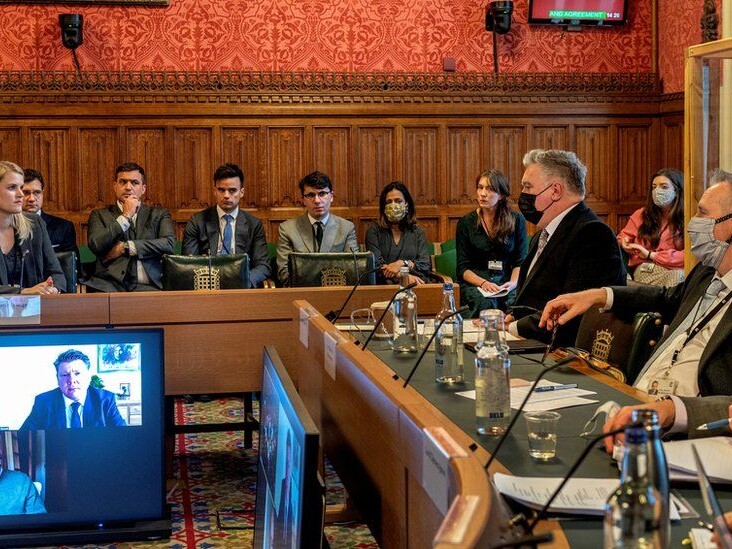
We recently debated an excellent report by a House of Lords Special Enquiry Select Committee, the Engagement with Space Committee. This is what I said.
My Lords, as a former member of the committee—all of us, I suppose, could be described as space cadets—I warmly thank the noble Baroness, Lady Ashton of Upholland, for her superb chairing of the committee and for her inspiring introduction today. I join her and other members of the committee in thanking all the staff and advisers to the committee, and all our evidence givers, including the celebrities that the noble Baroness mentioned. I also thank all noble Lords who have contributed so enthusiastically to this extremely illuminating debate.
As the noble Baroness, Lady Stowell of Beeston, said, the title of the report absolutely captures the challenge. It serves as both a stark warning and a brilliant road map for our future. As we have heard today, the UK space sector is an invaluable national asset. It generates nearly £19 billion a year in income, directly employs over 52,000 people in highly skilled jobs and underpins approximately 18% of our entire
GDP—some £364 billion. We possess immense comparative strengths that we must champion, from Glasgow, which builds more small satellites than anywhere else outside California, to our pioneering in-orbit servicing, assembly and manufacturing—ISAM—sector. We also boast unique downstream advantages, with the City of London primed to be the pre-eminent global centre for space finance, law and insurance.
As we have heard today, the UK space sector is an invaluable national asset, but we must not be complacent: the hard data shows that the UK’s global market share in space has fallen from 5.1% in 2020 to just 4.2% in 2023. We are sliding backwards because our nearest competitor nations are aggressively ramping up their public investments while the UK relies on short-term, fragmented funding cycles. As we consider these economic opportunities, we must be clear-eyed about the intense international competition that we face, particularly the overwhelming dominance of the United States. The recent record-breaking IPO of SpaceX vividly illustrates the sheer scale of American financial and industrial might in this domain.
The noble Lords, Lord Willetts and Lord Shamash, and the noble Baronesses, Lady Ashton and Lady Mobarik, have talked about the importance of sovereign UK launch capability. The committee’s report was right to warn that the UK and the rest of the world have become dangerously overreliant on a single commercial entity for orbital launch and satellite communications. This is a profound strategic vulnerability. We cannot simply outsource the resilience of our critical national infrastructure to a single overseas monopoly, nor to the unpredictable political and commercial whims of one billionaire. This stark reality underscores exactly why the Government must step up as an anchor customer to help our own domestic firms scale up and why we must urgently pool our sovereign capabilities with our European partners.
To truly grasp the scale of this domestic opportunity, we need only to look at our world-leading capabilities in earth observation, which were focused on in particular by the noble Lord, Lord Lansley. Satellite data is rapidly becoming the new gold of the global economy. Earth observation is vital for monitoring climate change, tracking deforestation, predicting natural disasters and enabling precision agriculture. Yet, as the committee heard, adoption of these services outside the space sector remains far too slow because many organisations still view space as complex or irrelevant.
This is exactly where the Government must step in. By acting as a smart procurer, buying earth observation data to improve our own public services, whether for national flood mapping, monitoring coastal erosion or infrastructure planning, the Government can act as an anchor customer. This would immediately de-risk private investment, help our innovative SMEs to scale up and ensure that the UK captures its rightful share of this market. I very much appreciated what the noble Baroness, Lady Stowell, said on the whole scale-up aspect.
But space is no longer just an economic frontier. It is, as many noble Lords said, a critical national infrastructure. It is increasingly congested, contested and competitive. Our national security and resilience
rely heavily on the space domain, from tracking climate change to the vital encrypted communications provided by our Skynet military satellites. To secure these economic and security benefits, the committee’s message is unequivocal: the UK Government must provide a coherent, funded strategic direction. Industry is crying out for the Government to pivot from being a small-scale grant funder to acting as a reliable, smart anchor customer. Procurement contracts, rather than just R&D grants, as noted by the noble Baroness, Lady Ashton, are essential to de-risk projects, crowd in private capital and help our brilliant SMEs to scale up into globally competitive businesses.
Yet the Government’s official response to this excellent report is frankly lacking in the urgency required. Instead of publishing the detailed national space capability development plan that the sector needed and which the committee demanded by the end of 2025, the Government deferred the hard details to a spring space publication, as described by the noble Lord, Lord Lansley. Now it seems that they have promised a plan for space for later this year. Can the Minister confirm exactly what is intended? This deferral of decisions is simply not good enough. As Professor Sylvester Kaczmarek powerfully highlighted in his recent briefing to Peers, deep tech firms cannot scale their businesses on what are described as future documents. The Government’s response offers process when industry desperately needs delivery.
I therefore press the Minister on three specific matters. First, given the Government’s insistence on absorbing the UK Space Agency into DSIT, will they urgently publish a clear accountability map so that industry knows exactly who owns strategy, procurement and regulation across Whitehall? Secondly, when will the Government publish a concrete procurement route that includes specific targets for SME participation? Thirdly, how do the Government plan to create an open assurance pathway for the complex AI-driven autonomous missions of the future? If we want to lead the world in active debris removal, so positively mentioned by the noble Viscount, Lord Stansgate, and the noble Baroness, Lady Bennett, and secure space operations, we must have the regulatory frameworks to prove that these AI systems are trustworthy and secure.
I am afraid that the Government’s response to this committee is characterised by a failure to grasp the nettle. They have not only absorbed the UK Space Agency into a Whitehall department but explicitly rejected the committee’s sensible recommendation to appoint a dedicated Minister for Space to drive cross-government co-ordination.
We on these Benches align very closely with the committee’s recommendations. On European co-operation, the committee rightly called for urgent decisions on our participation in flagship EU programmes such as Galileo and IRIS2 to provide industry with certainty. The Government have stated that they cannot make decisions yet. We are clear that we must pool our sovereign satellite navigation capacity by fully rejoining the Galileo system and confirming our participation in IRIS2. We cannot rely solely on foreign-owned systems for our critical position, navigation and timing needs.
On governance and strategic focus, the committee explicitly warned against the fragmentation of space policy across Whitehall and expressed deep concern over the absorption of the UK Space Agency into DSIT. We on these Benches believe that this merger is a strategic error. Why are the Government dismantling the autonomy of our national space agency at the very moment that it is proving its commercial worth? An independent UKSA is crucial to present a unified interface with the European Space Agency, maintain specialised technical focus, and champion UK interests internationally. We continue to call on the Government to reverse that decision.
We must tackle the skills gap mentioned by a number of noble Lords with genuine ambition, which includes implementing broader reforms to the apprenticeship levy to allow space firms the flexibility they need for responsive training and microcredentials. We cannot maintain our leadership on deferred decisions and structural dilution, so I urge the Minister to take the bold decisions identified by the committee, deliver a clear and actionable space strategy and, in the words of the report, act now before we lose out.


10th December 2022